A Snapshot

Posing for a snapshot, c 1960s (click to enlarge)
Posing for a snapshot, c 1960s (click to enlarge)

Brownie battle (c. 1920s)
The camera in at least the woman’s hand in this great shot looks to me to be a 1920s Kodak Brownie No. 3, Model B. According to what I have found online, the camera was produced from 1908 – 1934, but the trigger guard visible below her thumb was added to the Model B from 1920 – and the rest appears to match that particular camera, as shown below.

The way it used to work

Kodak’s Brownie No. 3, Model B

Peoples and Schatzel Streets, Corpus Christi, 1930 (click to enlarge)
This shot is dated February 11, 1930, notes the streets on the back and also mentions “Bay in background” – and you can indeed see it if you enlarge the photo enough. A quick check online reveals that unfortunately nothing in this photo seems to exist today. The block in the middle is open space, and the surrounding streets are occupied by the typical contemporary mishmash of larger buildings. Another step “forward” in American urban planning.
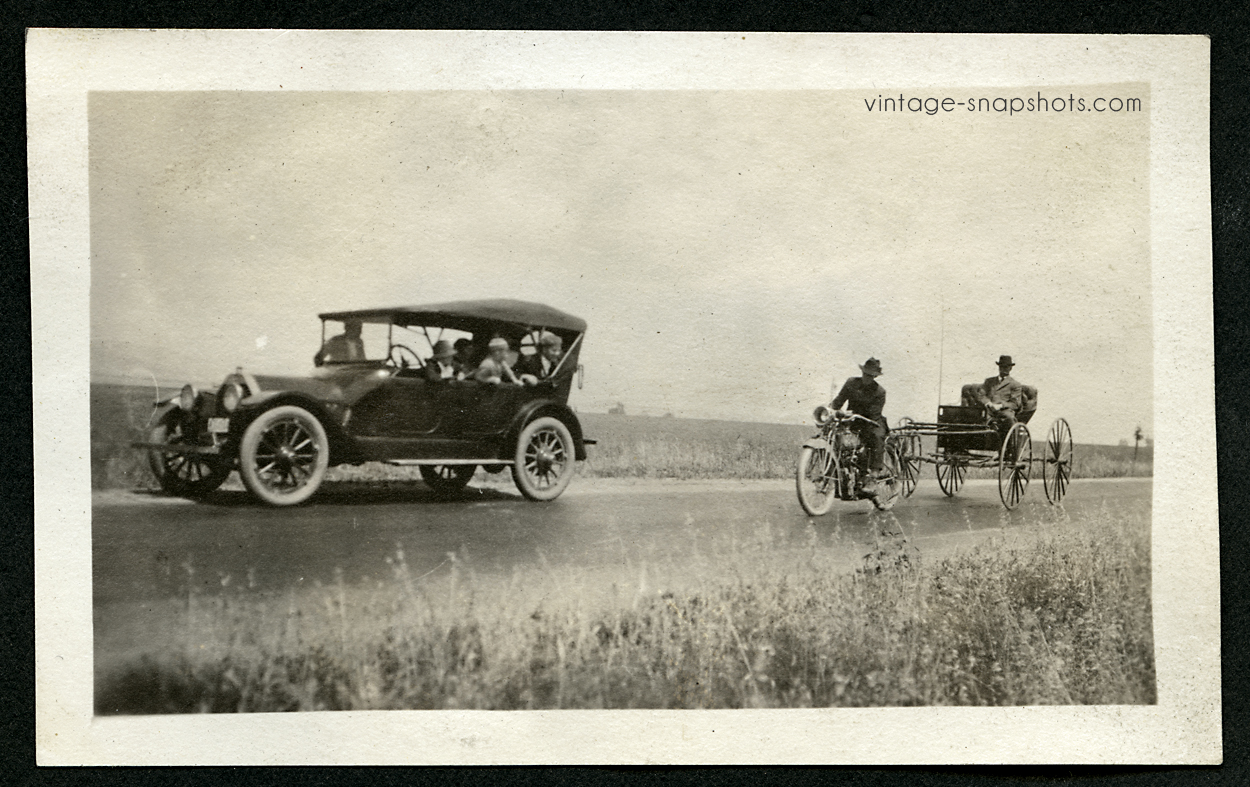
No horse needed (circa 1920s)
Following on from my last post, on a very early automobile being scrutinized by some people from their window, here is another transportation-related shot involving a transition between eras. It looks like it was probably a good way of getting around. The people in the car certainly seem intrigued.
I have always been curious about the period in which horses, buggies/wagons and cars coexisted, and several years ago met a man in his mid-nineties living in Covina, CA (near where I grew up) who described arriving there from Texas (via a just-opened Route 66) about 1927. He said people on horseback were still somewhat common in that small town at the time, though I don’t know about buggies or wagons.
I came across a sort of charming description of the transition to automobiles in a rural town in a 1960s book called The Situation in Flushing by Edmund Love:
“At the time of my birth, in 1912, the village of Flushing, in Michigan, was still in the horse-and-buggy age. There were only five automobiles in the whole village . . . it would be difficult to say just when it was that the automobiles outnumbered the horses and buggies on Main Street. The farm wagons disappeared one by one and the cars took their places, but I have always felt that I looked up one morning and found it all different. There were no horses and buggies left. Instead of five automobiles in the town there were five hundred.”

What looks to be an early Ford is the object of attention on the street
I found this shot over the weekend, and realized when I looked at it a little more closely at home that it may well depict a version of Henry Ford’s first car, something he completed in 1896 and called – in a nod, I assume, to the fact that it used bicycle components for its seat, tires, chain, etc. – the quadricycle. I have since learned that the car in the photo is a Curved Dash Oldsmobile. Notable for having been the first mass-produced automobile, it was produced from 1901 to 1907, with something over 19,000 being made in total.
Below is a photo of Henry Ford in a similar, earlier automobile, which had a two-stroke engine and could travel at about 20mph.
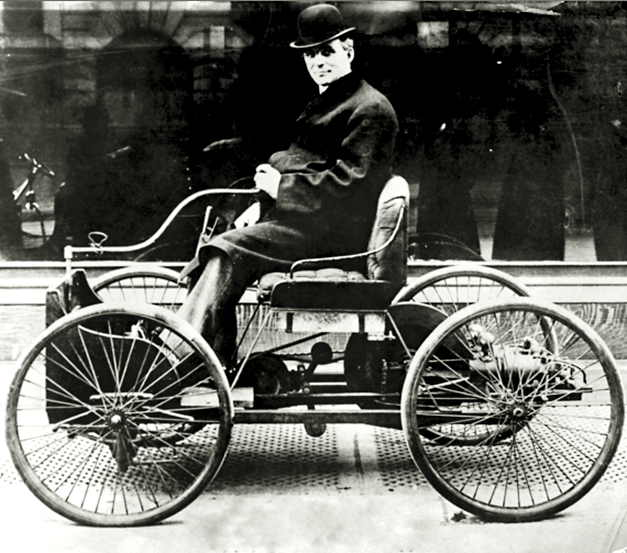
Henry Ford on his quadricycle; if that is a steering wheel in the reflection at left, his early machine was already old-fashioned at the point this was taken
What I find so great about this photo, however, is not just the car. It is the fact that if you look closely (and I have enlarged the relevant section below) you can see a woman holding a baby up to the window right behind the driver’s head. It would possibly have been one of the first times either had seen an actual automobile. What a different world was coming. One in which, among other things, parking would never be so easy again.

Gazing out at a new world (click to enlarge)
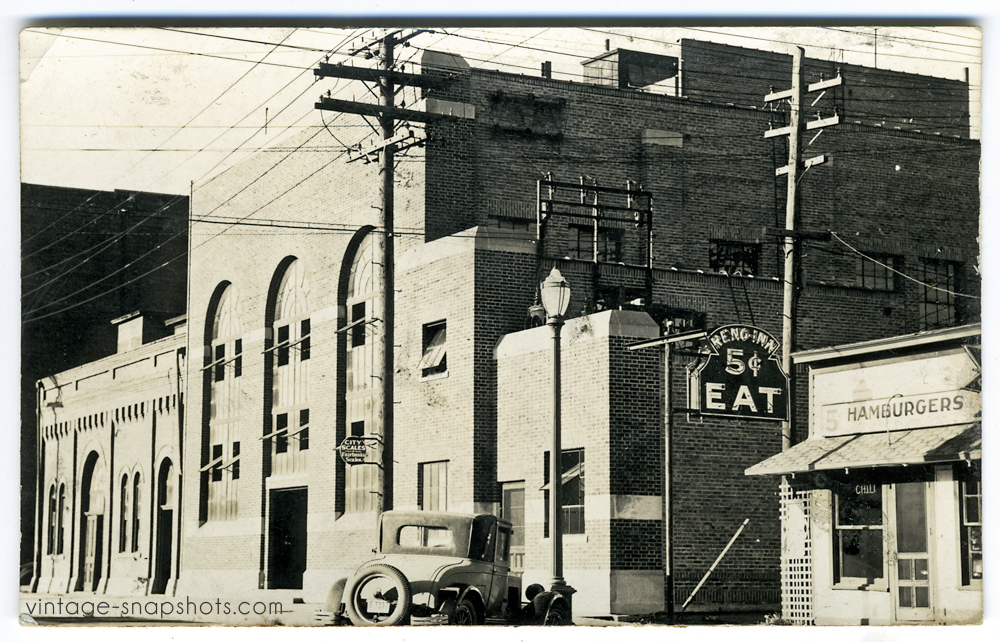
Five-Cent Diner with Car, 1937
This photo is dated August 1937 on the stamp on the rear – the year the Great Depression deepened after actually having eased somewhat in the previous few years. By the following year unemployment would hit 19%. I don’t know if five cents was a great deal back then for what they were offering, but I would imagine it must have been a pretty good price or they would not have featured it so prominently. In any case I like the directness of the sign: what else, really, did you need to know?
Apart from that, though, the photo is just pretty stunning for a snapshot, I think: the lines, the angle, the light, the lone automobile, the hulking building looming over the hamburger stand, and where the 5-cent sign ended up being placed compositionally. But was the photographer perhaps actually making a photo of the large building, and the corner of the diner just ended up getting in the way?

Conversation outside Acme Machinery Co., circa 1930s
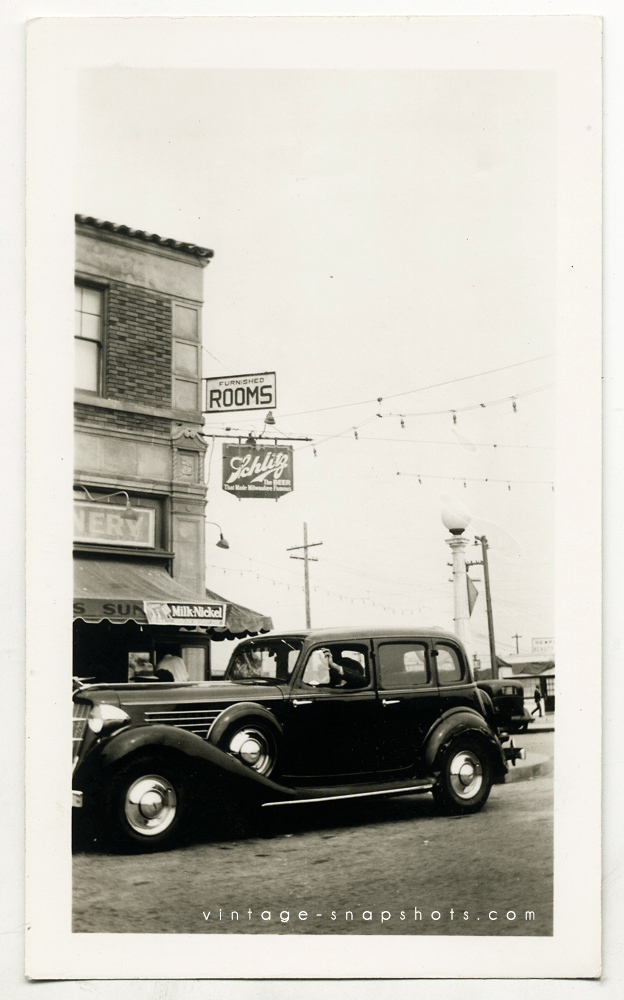
Car + signs, circa 1930s
I always like a good city scene, and this shot qualifies as one, I think. A lot of it comes down to those signs, of course…nicely framed against the sky.

Fern Steinbock, 1920s
Old photos often have the name of the subject(s) jotted down on the back or, sometimes – as here – the front, and those names can be just great. I have one somewhere (I’d have to find it or I would have posted it along with this shot) of four people posing, all identified on the rear and all bearing absolutely classic old-fashioned names. Not a single “David” or “Susan” or “Michael” or anything remotely like that among the lot.
“Fern” is definitely one of those names that has a classic ring to it. One site ranking the popularity of baby names says that its last year in the top 1000 names was 1961, but that it peaked in 1916, when it was number 152. I did come across a current Fern, however, and her account was kind of worth passing on, I thought. I like her spirit.
“Hey, my name is Fern, and at 16 years of age, I’ve only met one other Fern in my lifetime, and she was an 80 year old friend of my grandmothers. I’ve actually grown to like the name, but personally, if I was a mother, I’d go with something a little more conventional. Fern automatically singled me out from other kids, and there were some less-than-sweet children who made their opinions of my name known in elementary and middle school. I’ve actually found it easier to go by my middle name…
As you get older though, the teasing seems to die down.
Ugh, Charlotte’s Web comments were among the most resented! I can’t say how many clever boys and girls asked me ‘Hey, Fern, where’s Wilbur?’
But, in all the name has become almost a positive thing.”
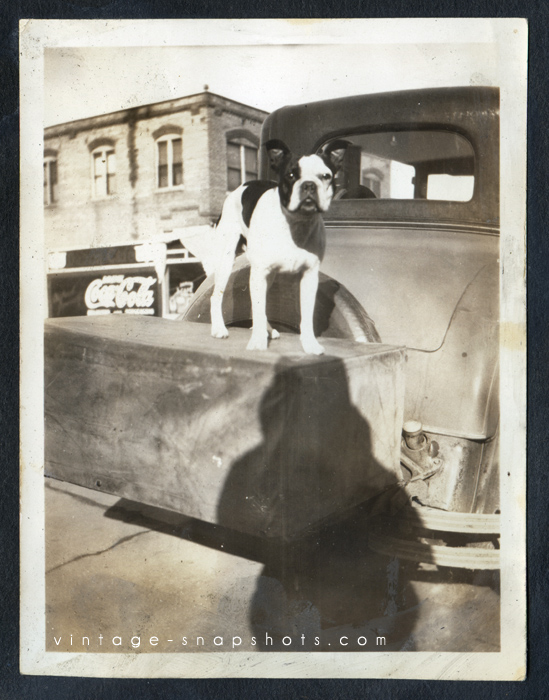
Dog with Shadow (1920s)
Apart from the fact that that might be a French bulldog – I’m not sure – this could be seen as a pretty “American” image, with the car, dog and Coke sign. Interestingly, though, it looks like this photographer was holding the camera to their face, not at waist level as in the previous post’s photos.
 Vintage Snapshots