Vintage Snapshots

the wondrous world of vernacular photography

City Views: Corpus Christi, Texas

Vintage photo of Corpus Christi, Texas in 1930

Peoples and Schatzel Streets, Corpus Christi, 1930 (click to enlarge)

This shot is dated February 11, 1930, notes the streets on the back and also mentions “Bay in background” – and you can indeed see it if you enlarge the photo enough. A quick check online reveals that unfortunately nothing in this photo seems to exist today. The block in the middle is open space, and the surrounding streets are occupied by the typical contemporary mishmash of larger buildings. Another step “forward” in American urban planning.

Summertime

Vintage photo of a young boy and girl leaping over a sprinkler

…and the livin’ is easy.

Given how hot it has been in a lot of places recently, I thought this was an appropriate shot – and quite beautiful in several respects, including how their front legs match up almost perfectly.

And since we are talking about summertime:

Two-Wheeled Horsepower

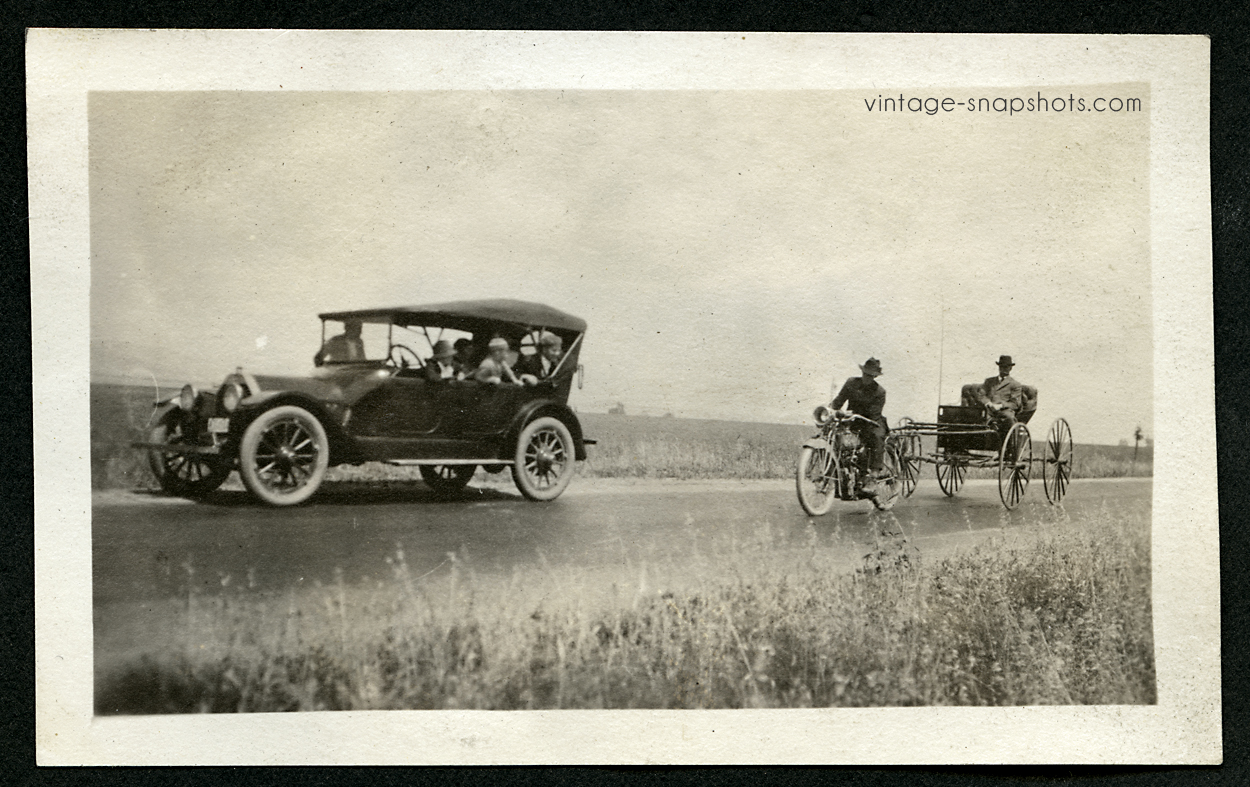
People in car marvel at a wagon towed by a motorbike in a 1920s photo

No horse needed (circa 1920s)

Following on from my last post, on a very early automobile being scrutinized by some people from their window, here is another transportation-related shot involving a transition between eras. It looks like it was probably a good way of getting around. The people in the car certainly seem intrigued.

I have always been curious about the period in which horses, buggies/wagons and cars coexisted, and several years ago met a man in his mid-nineties living in Covina, CA (near where I grew up) who described arriving there from Texas (via a just-opened Route 66) about 1927. He said people on horseback were still somewhat common in that small town at the time, though I don’t know about buggies or wagons.

I came across a sort of charming description of the transition to automobiles in a rural town in a 1960s book called The Situation in Flushing by Edmund Love:

“At the time of my birth, in 1912, the village of Flushing, in Michigan, was still in the horse-and-buggy age. There were only five automobiles in the whole village . . . it would be difficult to say just when it was that the automobiles outnumbered the horses and buggies on Main Street. The farm wagons disappeared one by one and the cars took their places, but I have always felt that I looked up one morning and found it all different. There were no horses and buggies left. Instead of five automobiles in the town there were five hundred.”

Window Onto a New World: The Curved Dash Oldsmobile

Man sits in early Ford automobile outside house while people stare through window

What looks to be an early Ford is the object of attention on the street

I found this shot over the weekend, and realized when I looked at it a little more closely at home that it may well depict a version of Henry Ford’s first car, something he completed in 1896 and called – in a nod, I assume, to the fact that it used bicycle components for its seat, tires, chain, etc. – the quadricycle. I have since learned that the car in the photo is a Curved Dash Oldsmobile. Notable for having been the first mass-produced automobile, it was produced from 1901 to 1907, with something over 19,000 being made in total.

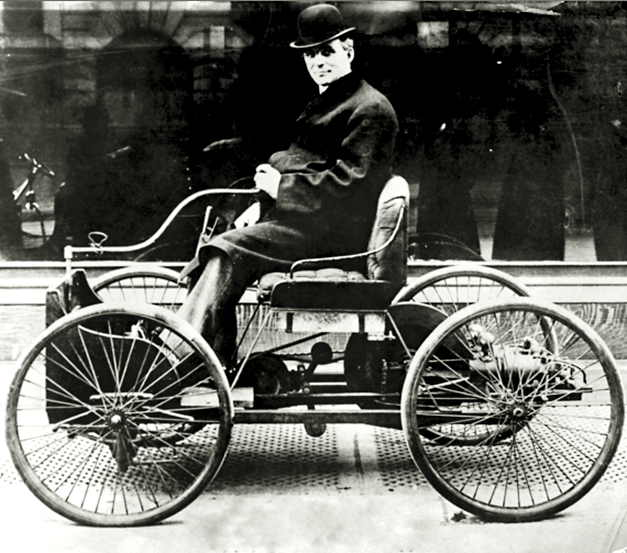
Below is a photo of Henry Ford in a similar, earlier automobile, which had a two-stroke engine and could travel at about 20mph.

Early Ford automobile, the quadricycle, with Henry Ford driving

Henry Ford on his quadricycle; if that is a steering wheel in the reflection at left, his early machine was already old-fashioned at the point this was taken

What I find so great about this photo, however, is not just the car. It is the fact that if you look closely (and I have enlarged the relevant section below) you can see a woman holding a baby up to the window right behind the driver’s head. It would possibly have been one of the first times either had seen an actual automobile. What a different world was coming. One in which, among other things, parking would never be so easy again.

People gaze out of a window at the newest thing: the car

Gazing out at a new world (click to enlarge)

A Happy Mistake

Vintage photo of a dog jumping out of the frame, circa 1920s

Up in the Air, circa 1920s

Or at least I assume this result was not exactly what they were trying to achieve. If they were, more power to them. It is sort of a particularly well-composed shot as it stands, and is one of my favorite images at the moment. It makes me at least wonder, though, how many digital photos today may end up being deleted should they at first glance appear something of a mistake.

Wired Woman

Vintage 1960s image of a woman posing in front of a telephone pole

Well-placed woman (circa 1960s negative)

Following up on a previous post about heads intersecting with background elements, here is another example of a woman captured without too much attention having been paid to where she was standing – unless, of course, they were actually trying to give her head that extra ‘something’.

City Views: Detroit’s Madison Theatre

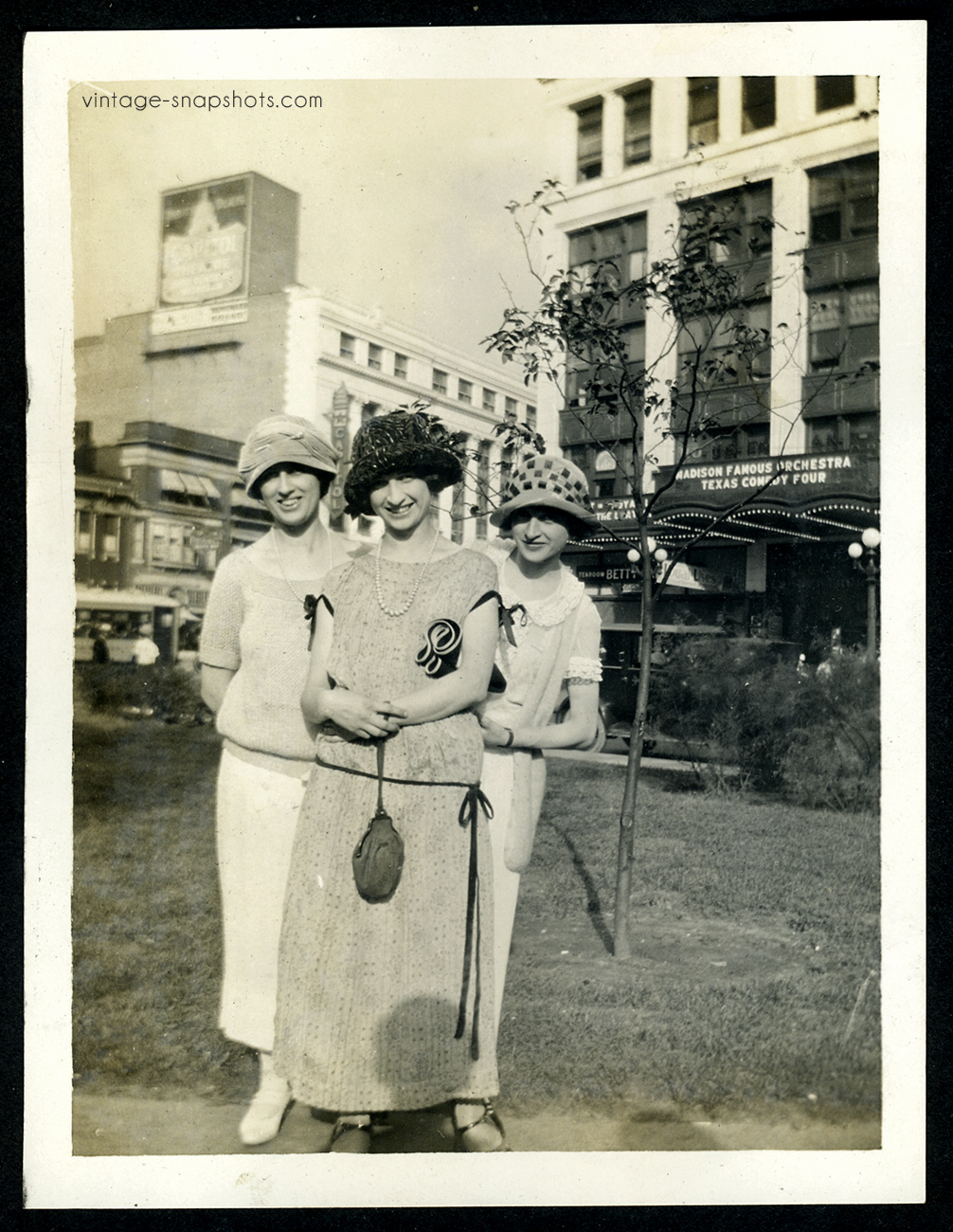
Three "flapper" women stand in front of the former Madison Theatre in Detroit, 1920s

A sunny day in Detroit's theater district, circa 1920

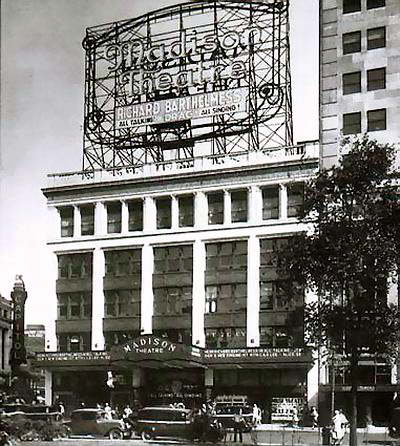
This photo shows the Madison Theatre – part of what was then Detroit’s theater district, Grand Circus Park – at right. The theater itself no longer exists, but the office building that it was part of is still there. (Apparently many theaters of the 1910s and ’20s were built attached to office structures in case motion pictures turned out to be a passing fad.) Constructed in 1916, the theater sat just over 1800 people and was, as historicdetroit.org says, “a key link between the small Detroit theaters of the turn of the century and the extravagant movie palaces that would rise in the 1920s.” The Madison would go on to be the first theater in Michigan to screen a feature-length talking picture when it showed “The Jazz Singer” at the end of 1927. It closed in 1984. The last movie shown was “The Dead Zone,” and the title remained on the marquee for years.

Here is a shot of the remains of the lobby taken by David Kohrman of the excellent forgottendetroit.com, just before the space was razed in 2000.

The staircase in the lobby of the Madison Theatre in ruins before demolition

The remains of the staircase in the lobby of the Madison Theatre, 2000 (David Kohrman)

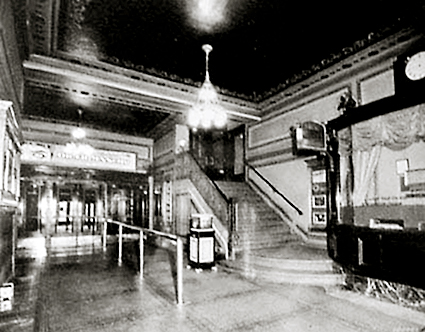
It’s a little blurry, but here is a view of the lobby in its heyday.

Photo of the lobby of the Madison Theater in its prime, circa 1920s

The Madison in its prime

Lastly, here is a fuller view of the exterior around the time the snapshot would have been taken, although the marquee is slightly different.

Vintage image of the Madison Theatre facade, circa 1920s

Detroit's Madison Theatre, circa 1920s

The building that housed the theater seems to be doing well. According to a story on CBS Detroit from earlier this year, “the 1917-vintage Madison Theatre Building — now rechristened The M@dison by its new owner, Dan Gilbert and his Rock Ventures LLC — has been given a spectacular $12 million makeover into some of the coolest work space anywhere.” Coincidentally, the same year the theater space was demolished, the Detroit Tigers’ new stadium, Comerica Park, opened up nearby, and they say there is a great view of the ballpark from the upper floors. That sounds pretty good, but I can’t help envying the women in the snapshot, who could have gone to see Ty Cobb at the old Tiger Stadium (known as Navin Field in that era) – perhaps that very afternoon.

In the Background

1920s photograph of females embracing, small girl in far background

The girl in the corner, circa 1920s (click to enlarge)

I often find it intriguing when there is a person in the background who is captured (usually) by chance – such as the young girl tucked away near the corner of the house, looking towards the camera (which you can make out more clearly when you enlarge the image).

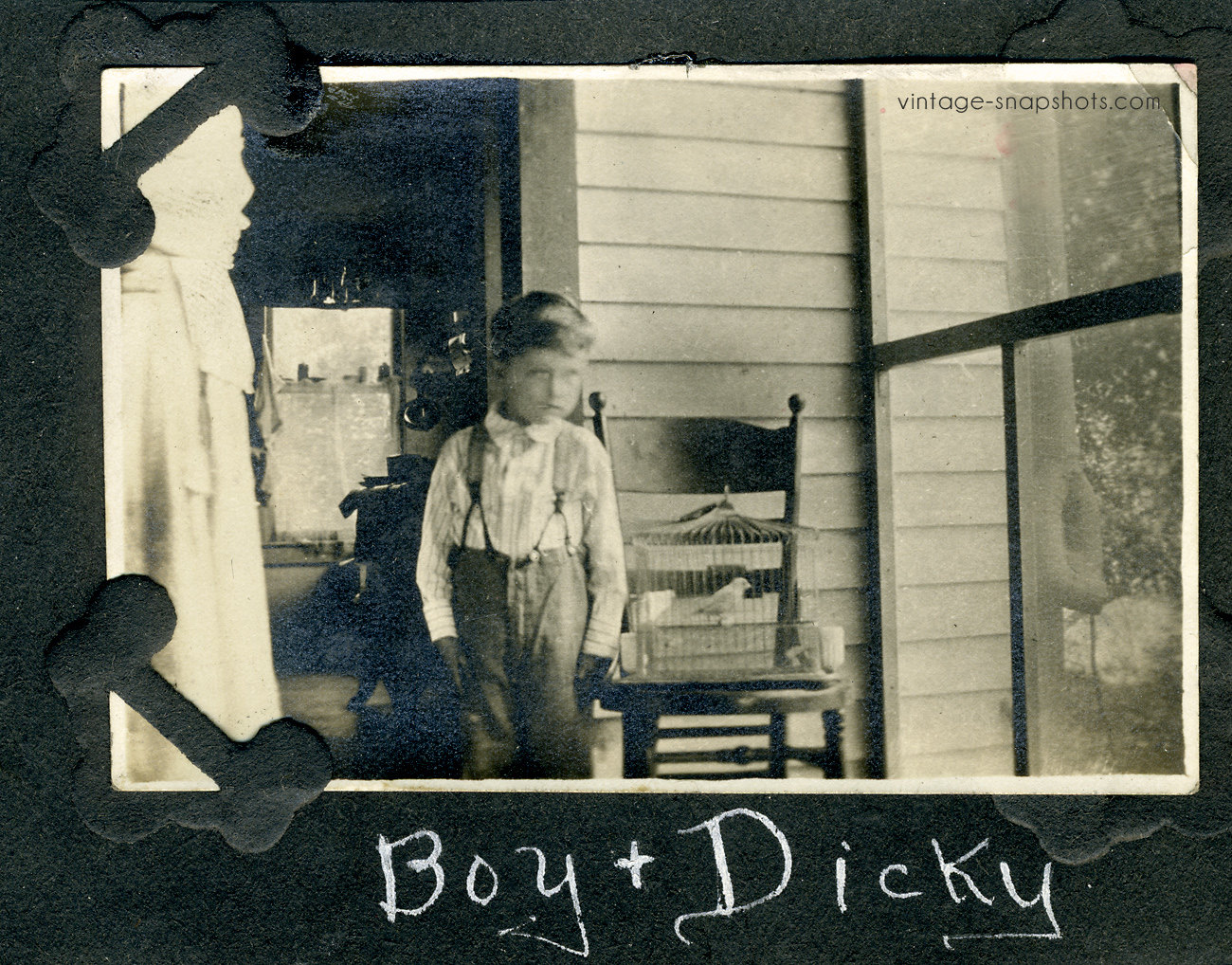
A Bird Named Dicky

Vintage (circa 1910s) photograph of a boy and his caged bird posed on their porch.

Unnamed boy with a bird named Dicky (1918)

A boy, a bird, and an open door – as well as, presumably, a mother overseeing things to the left. Oddly, in the many shots in which he appears in the photo album from which this was taken the youngster is always identified as “Boy,” while the little bird has a name.

Shooting at Water and Other Pursuits

Horses pull a wagon across a river in vintage photograph

Crossing a river, c. 1900

Here are three great snapshots in, on and around water.

Woman piloting a speedboat across the water in old photo from the 1920s

Speedboat, c. 1920s

Vintage photo of a 1960s young woman shooting a gun at ocean

Gun Woman, 1966

Design a site like this with WordPress.com
Get started