A Snapshot

Posing for a snapshot, c 1960s (click to enlarge)
Posing for a snapshot, c 1960s (click to enlarge)
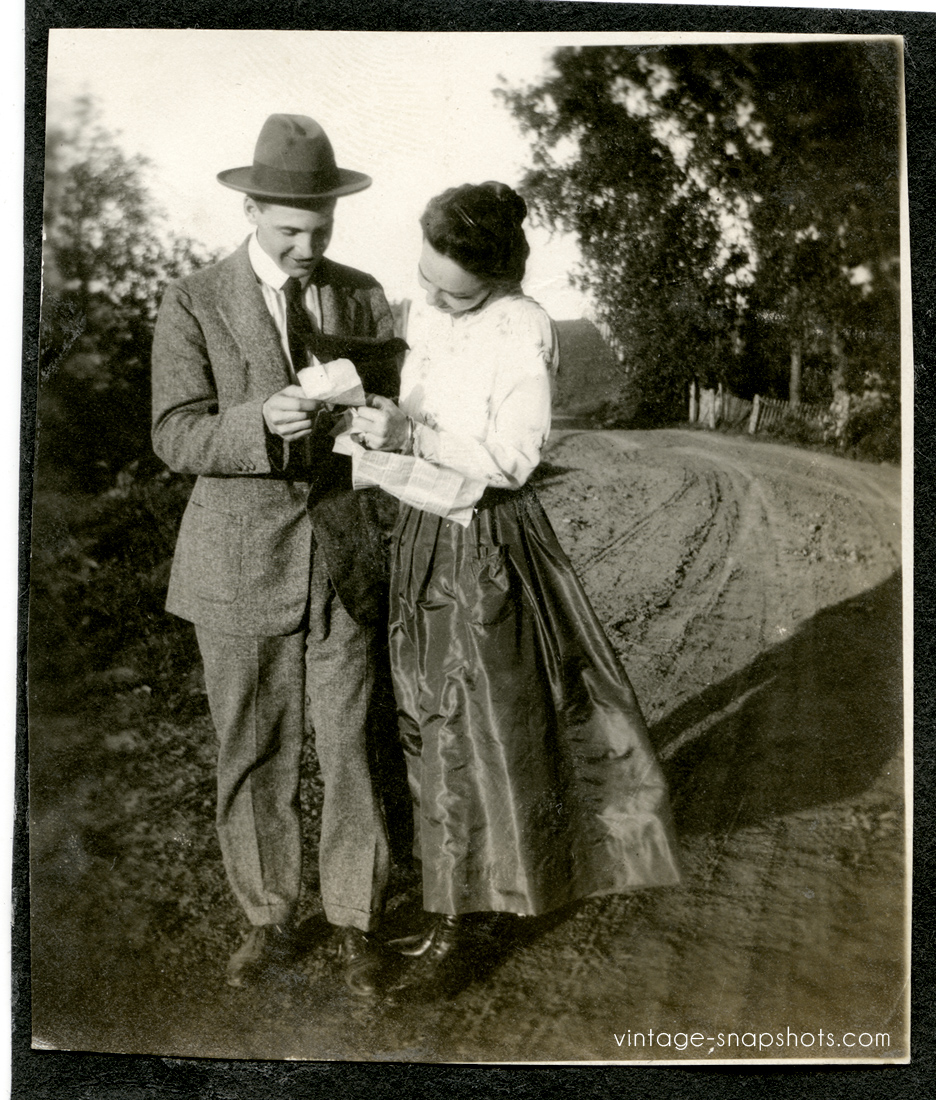
A letter? (circa 1911)

A day in the San Gabriel Mountains, c 1908 (click to enlarge)
The San Gabriel Mountains begin north and east of the city of Los Angeles and range for over 60 miles, reaching a height of just over 10,000 feet at their highest point, Mt. San Antonio (better known as Mt. Baldy). Living in L.A. I often come across images taken on Mt. Wilson — the nearest large peak to the city and home to an Observatory as early as 1908 — and in the various nearby canyons, which have long attracted hikers. This circa 1908 shot shows one well-dressed group, and also has a rather charming approach to its border that I have not seen very often.
The San Gabriel Mountains are still quite rugged if you venture far enough into them, and are notable for remaining geologically active: they actually are said to be growing at a rate of 2 inches per year. As Wikipedia points out, “various faults crisscross the range, making it one of the steepest and fastest-growing ranges in the world. Plate tectonic activity breaks up most rock, making it unsuitable for rock climbing.”
Indeed, an interesting article on the history of the mountains on local public TV station KCET’s website observes that “although they don’t soar as high as the Sierra Nevada nor offer the same diversity of flora and fauna, the San Gabriels’ steep escarpments and deep ravines can challenge experienced adventurers. Even such a tireless trekker as John Muir met his match in the mountains. After an 1877 hike above Eaton Canyon, Muir described the San Gabriels as the place where ‘Mother Nature is most ruggedly, thornily savage.’ Chaparral provided the greatest nuisance — the prickly brush reduced Muir to crawling on his hands and knees for at least a mile — but the rugged terrain also merited a complaint. ‘The slopes are exceptionally steep and insecure to the foot of the explorer, however great his strength or skill may be,’ he wrote.”
Given the way the group in the photo is dressed, one can only assume they avoided sampling too much of that aspect of the mountains.
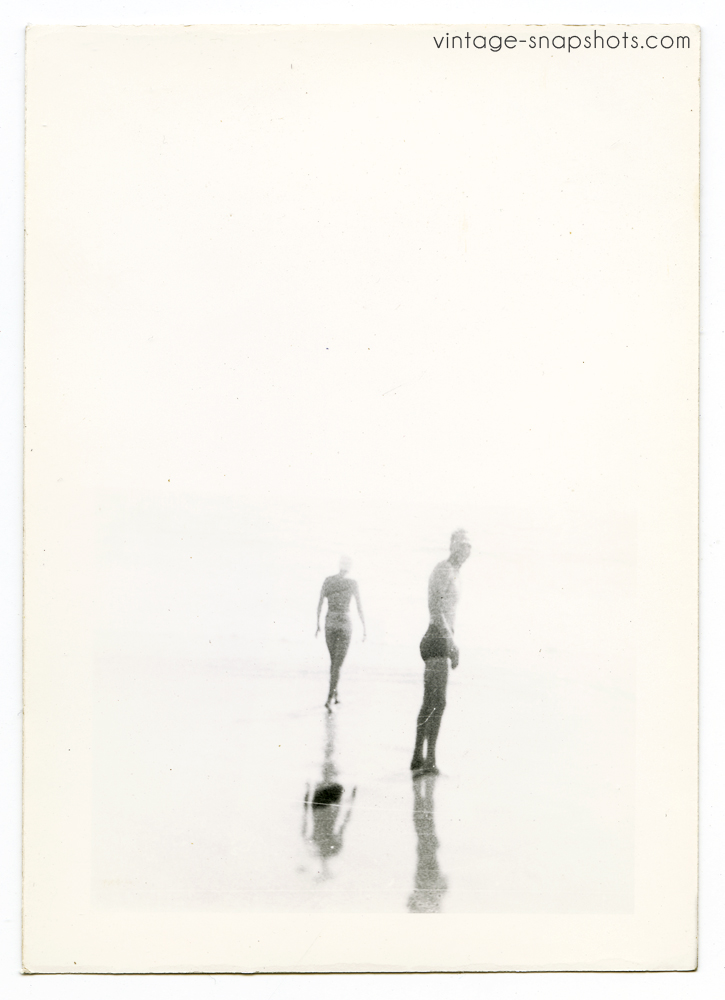
Beach reverie, 1944
This is labeled “Laguna ’44” on the back, for Laguna Beach, CA. Thanks to the keen-eyed Mike Conger for gifting this amazing shot — an estate sale find, I believe — to me yesterday.

Caught unawares, or just uncooperative? (c. 1960s)

Abstract interior scene, circa 1940s

Brownie battle (c. 1920s)
The camera in at least the woman’s hand in this great shot looks to me to be a 1920s Kodak Brownie No. 3, Model B. According to what I have found online, the camera was produced from 1908 – 1934, but the trigger guard visible below her thumb was added to the Model B from 1920 – and the rest appears to match that particular camera, as shown below.

The way it used to work

Kodak’s Brownie No. 3, Model B
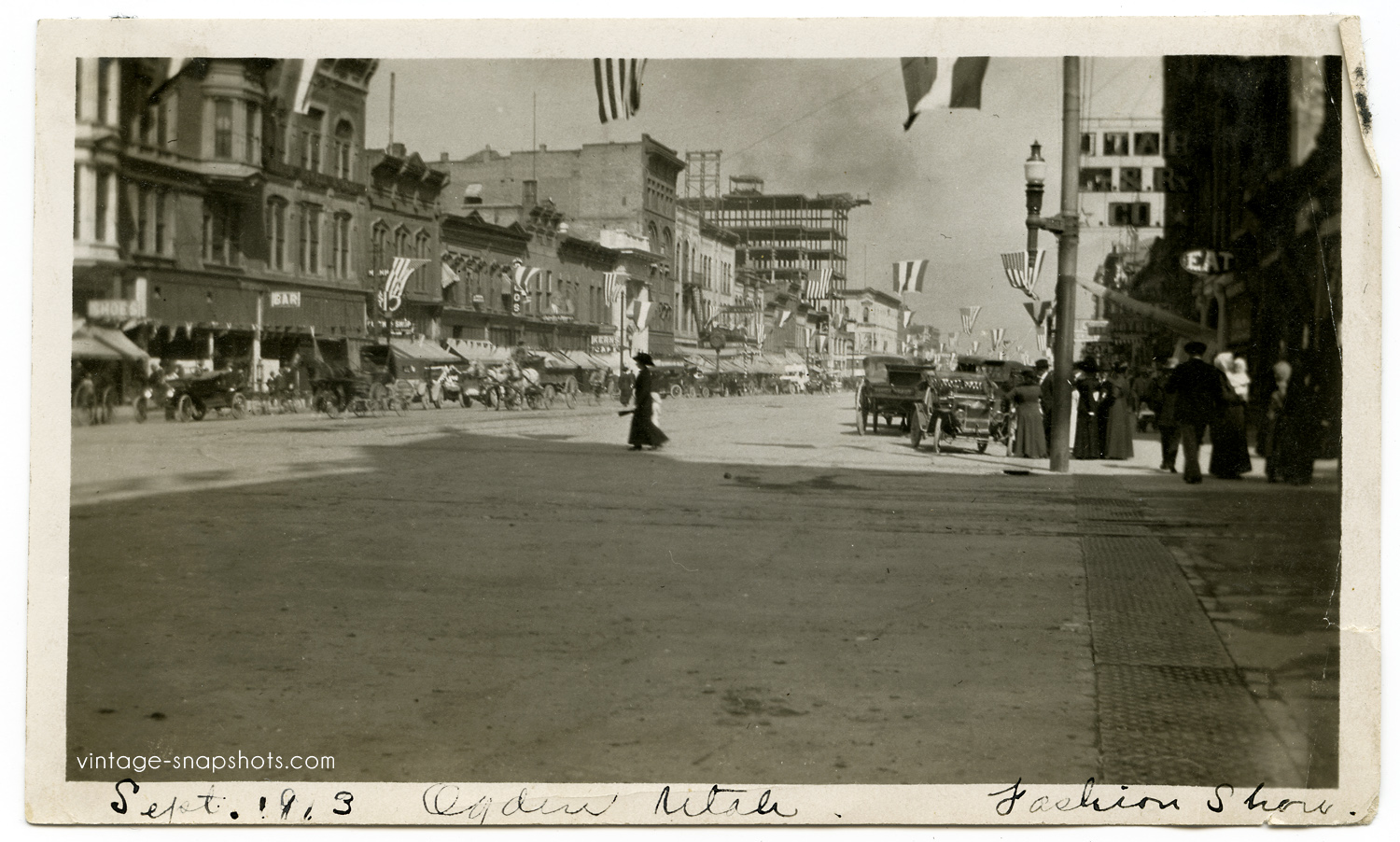
Making one’s way through downtown Ogden, Utah, 1913 (click to enlarge)
This photo is dated Sept. 1913 and is labeled “Fashion Show” at bottom right – and the streets do appear to have been decorated for an event. What I find intriguing, though – apart from the horse and buggy/automobile combination I talked about previously – are the signs you can just about make out. At far left there is a blurry one for “Shoes,” while the next door down is “Bar,” and across the street you find “Eat.” Nice and simple.

What looks to be an early Ford is the object of attention on the street
I found this shot over the weekend, and realized when I looked at it a little more closely at home that it may well depict a version of Henry Ford’s first car, something he completed in 1896 and called – in a nod, I assume, to the fact that it used bicycle components for its seat, tires, chain, etc. – the quadricycle. I have since learned that the car in the photo is a Curved Dash Oldsmobile. Notable for having been the first mass-produced automobile, it was produced from 1901 to 1907, with something over 19,000 being made in total.
Below is a photo of Henry Ford in a similar, earlier automobile, which had a two-stroke engine and could travel at about 20mph.
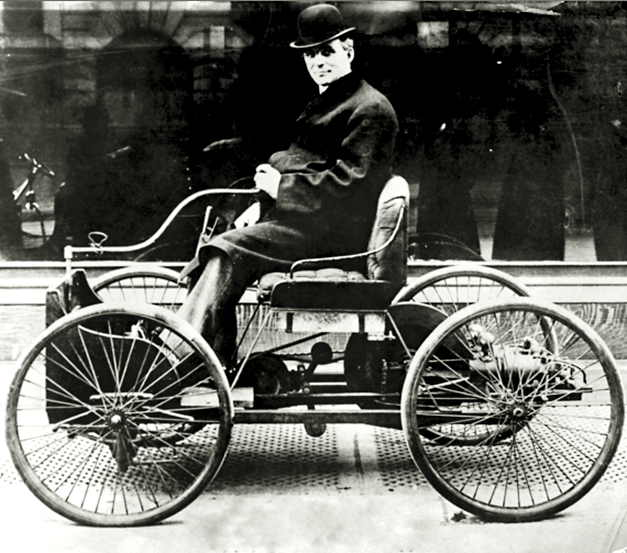
Henry Ford on his quadricycle; if that is a steering wheel in the reflection at left, his early machine was already old-fashioned at the point this was taken
What I find so great about this photo, however, is not just the car. It is the fact that if you look closely (and I have enlarged the relevant section below) you can see a woman holding a baby up to the window right behind the driver’s head. It would possibly have been one of the first times either had seen an actual automobile. What a different world was coming. One in which, among other things, parking would never be so easy again.

Gazing out at a new world (click to enlarge)

Well-placed woman (circa 1960s negative)
Following up on a previous post about heads intersecting with background elements, here is another example of a woman captured without too much attention having been paid to where she was standing – unless, of course, they were actually trying to give her head that extra ‘something’.
 Vintage Snapshots