Into the Void
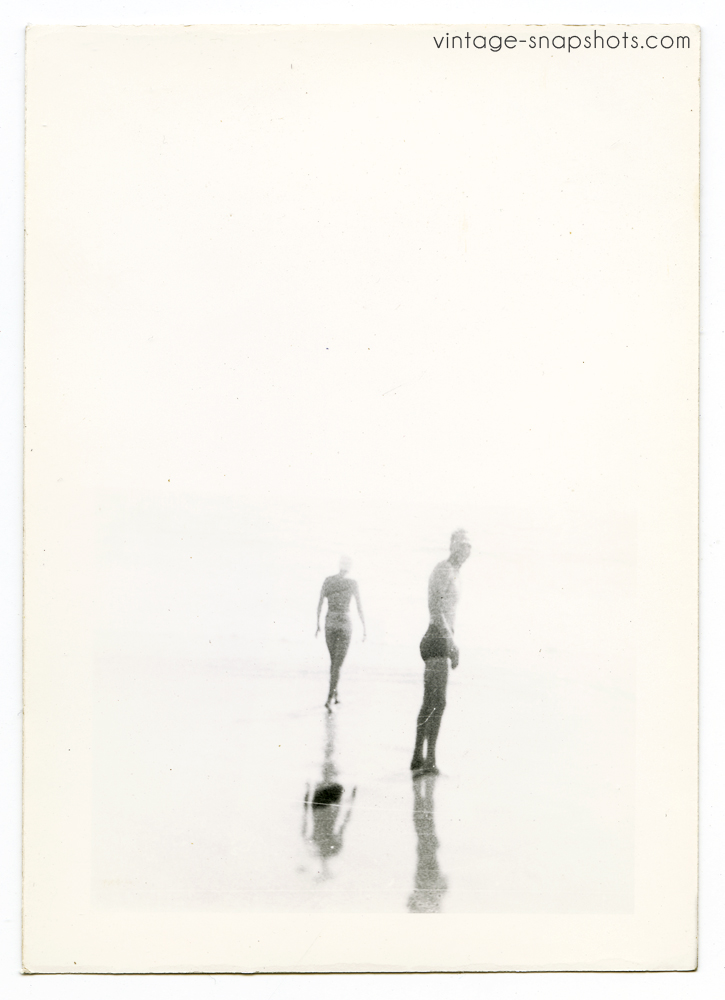
Beach reverie, 1944
This is labeled “Laguna ’44” on the back, for Laguna Beach, CA. Thanks to the keen-eyed Mike Conger for gifting this amazing shot — an estate sale find, I believe — to me yesterday.
Beach reverie, 1944
This is labeled “Laguna ’44” on the back, for Laguna Beach, CA. Thanks to the keen-eyed Mike Conger for gifting this amazing shot — an estate sale find, I believe — to me yesterday.

Abstract interior scene, circa 1940s

Quite a kid (circa 1940s)
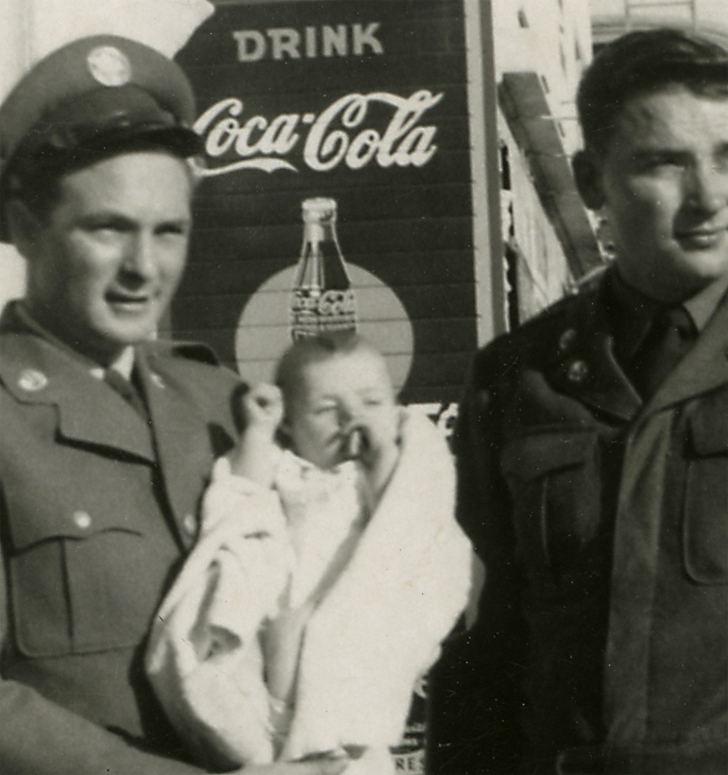
Another in the “background” series, I love how this baby’s head seems both to be surrounded by a halo and to have a bottle sticking out of it. This was found in the Bay Area and was likely taken somewhere in San Francisco or the East Bay. I wonder if any trace of the sign remains. There is something appealing about the old signs that were hand-painted on buildings (as this was one was; you can see the lines of the siding running through it), and there are several websites devoted to ones that remain, sometimes called “ghost signs.”
Here is a link to a 2005 New York Times article on them, and some nice examples can be found on this flickr page, titled “Vanishing Beauty.”
Here is a close-up of Coke baby.
Drink Coca-Cola
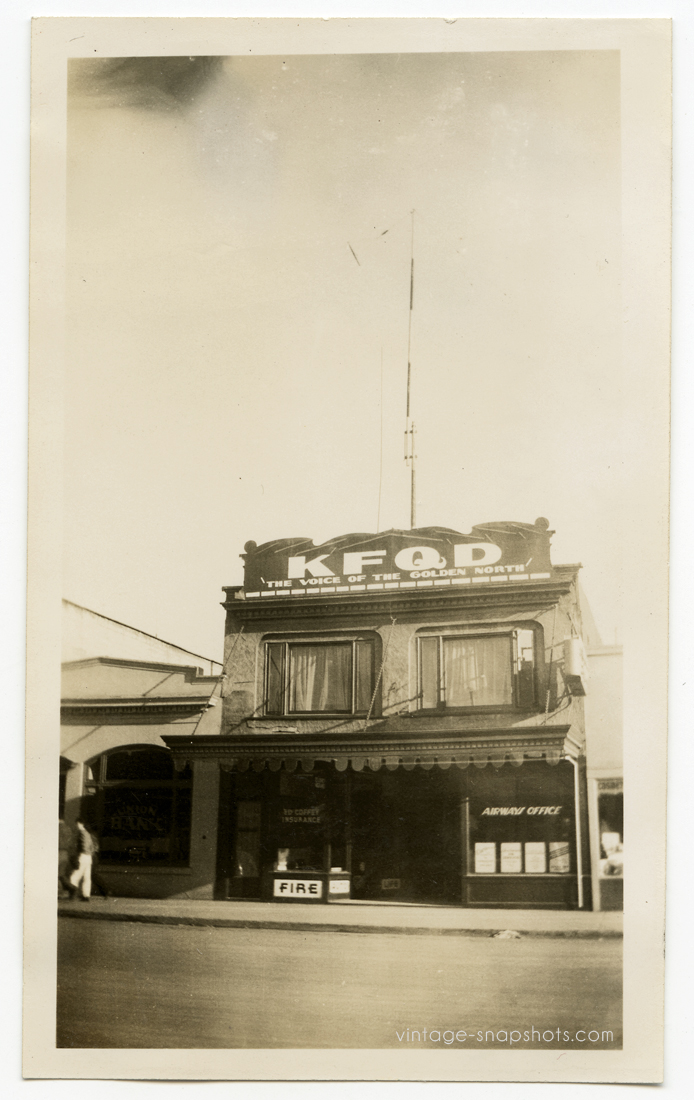
KFQD: “The Voice of the Golden North” (circa 1946)
This is a circa 1940s shot of the premises of KFQD Radio in Anchorage. KFQD still exists, and was, according to its website, the first radio station in Alaska, having begun broadcasting in 1924. Funnily enough, they actually have a similar photo on their “About Us” page, part of which I have reproduced below. In case you are dying to know, the window to the left sports a sign for Ed Coffey Insurance, and the one on the right says “Airways Office.”

A snowy day at KFQD, from the station’s website

…and the livin’ is easy.
Given how hot it has been in a lot of places recently, I thought this was an appropriate shot – and quite beautiful in several respects, including how their front legs match up almost perfectly.
And since we are talking about summertime:

Black bear w/ cub in search of a handout – or trying to steal a car
Vintage photos of bears begging for food from cars in parks like Yellowstone are fairly common. The practice seems to have started surprisingly early on, according to a site dealing with the history of such things at Yellowstone: “In 1910, the first accounts of black bears begging for human food handouts along park roads were reported. By the 1920s roadside ‘panhandling’ by black bears for human food handouts was common… As park visitation and the number of bear-human conflicts began to increase, park managers became more concerned with the situation. Between 1931 and 1959, an average of 48 park visitors were injured by bears and an average of 138 cases of bear-caused property damage were reported each year.”
This shot shows what may have been a sort of training session, with the mother observing as the little one is unable to even reach the window. The photographer seems to have been not that fearful, as he/she was a little over half a car-length from the action…perhaps unaware that about 48 people would be mauled that year. (Wildlife photographer Harry Morse, who visited Yellowstone during that era, remarks that “As a child I thought it was great that bears begged for food along the roads of Yellowstone. Park officials kept a lid on the annual number of people getting mauled and when it happened you didn’t hear about it.”) The practice is, of course, now banned – along with just about everything else in today’s world. Here is a nice color shot from National Geographic showing a couple of bears being photographed by onlookers.

Kiss with Shadow (1940s)
Something you often see in vintage snapshots is not just a shadow cast by the photographer, but one in which you can tell they are looking down through the camera rather than holding it to their face. That was, of course, just the way a lot of cameras were configured at the time. It also resulted – however slightly – in a different perspective, with the camera at waist height rather than the height of the subjects’ heads. I think you can see that here. Just another thing that gives these old images a little bit of their charm.
I also love this one, with its partial shadow, where you again can see the arms holding the camera at waist level.

Couple (1920s)
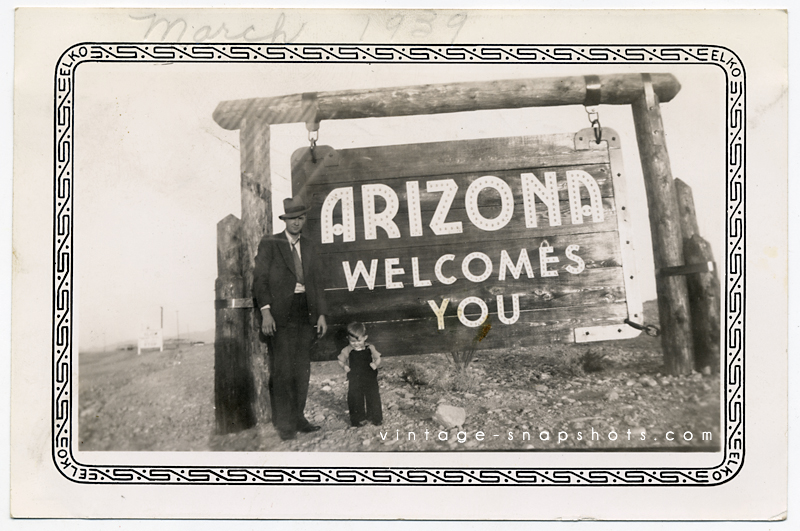
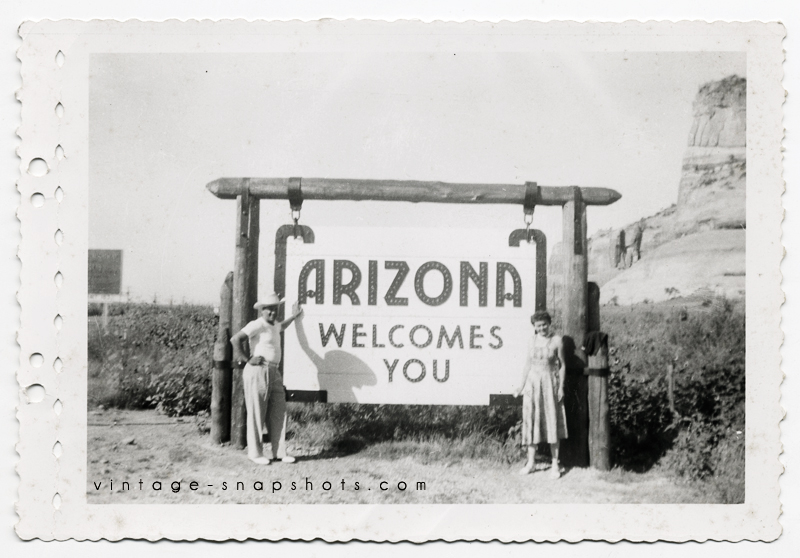
"Arizona Welcomes You" (1939)
A staple of vintage amateur travel photography is the shot of a person or persons next to a state-line welcome sign. In a lot of ways it must have been a somewhat bigger ‘event’ to venture into other states in, say, the 1930s or ’40s, before the dawn of the interstate highway system in the 1950s (and of course before air travel became such a common phenomenon). I like this image a lot – the suit and slightly rakish hat, the sign itself, and also just the warm, vintage tone of the photo. Somehow the angle also gives it something, I feel. I’m curious about their story.
Here is another Arizona sign, which is pretty similar. I’m not, however, as intrigued by this photo’s subjects.
"Arizona Welcomes You" (undated but likely '40s)
 Vintage Snapshots